Tuesday, 10 May 2011

Thor Review


With audiences already well acquainted with Iron Man and The Incredible Hulk, Marvel Studios bring two more characters from their roster of iconic heroes to the big screen this Summer, all whilst counting down the time until the release of their gargantuan super-powered team-up epic The Avengers next year. Whilst the release of Captain America: The First Avenger is still a few weeks away, the potentially difficult Thor marks the first true blockbuster of the Summer.

Of all the projects under Marvel Studios so far, Thor could easily have gone very wrong. Audiences are now completely desensitised to the standard ‘scientific-experiment-gone-wrong’ origin story of the majority of superheroes, and science-fiction in comic book films is commonplace. Thus, asking viewers to accept a decidedly geekier hero (Iron Man has a weaponised robotic suit, whereas Thor has a magical hammer called Mjolnir), with a setting rooted in Norse mythology alongside the aforementioned previously established heroes is a very different matter indeed. Luckily, Thor is a surging jolt of entertainment that may well rank as the Studio’s best effort yet.

In the realm of Asgard, King Odin (Anthony Hopkins) readies his first-born son Thor (Chris Hemsworth) to ascend to the throne, ahead of jealous younger brother Loki. When a security breach from ancient adversaries the Frost Giants halts the ceremony midway through, a rash and impulsive Thor retaliates, leading to his banishment from Asgard to present day Earth, where he finds an ally in scientist Jane Foster (Natalie Portman).

A particularly brave and inspired decision from Marvel was the choice of Kenneth Branagh to direct – the story, taking in sibling rivalry, betrayal and throne-envy, is aptly Shakespearean, and Branagh devotes enough time on character development to ensure that when the numerous action scenes arrive, which they most certainly do, you’ll genuinely care about the outcome. Luckily, he also knows how to direct a battle sequence or two – they are incredibly exciting, with an interesting variation on the same old superpowers we’re used to seeing. A particular highlight comes early on in a pulse-pounding fight between Thor and several Frost Giants.

Most impressively though, Branagh maintains a perfect tone throughout. Thor takes itself seriously when it needs to - you’ll invest in the characters, marvel at the breathtaking action sequences and be drawn into some of the weightier plot points. Yet its tongue is firmly in cheek when it wants to be, and the whole thing is tremendous fun. With several moments of well-judged laugh-out-loud humour, often courtesy of Sif and the Warriors Three, Thor is a film aware of its own potential silliness, and so never lets the grandiose scale of Asgard become laughably portentous.

In terms of scale, Thor feels huge - in the Marvel universe, it doesn’t get much more epic than Asgard and the Nine Realms, and the gorgeous art direction provides a truly otherworldly feel to proceedings.

In the lead role, newcomer Chris Hemsworth is extremely impressive, displaying not only gigantic biceps but decent acting chops, excellent comic timing and considerable charm that should see his Hollywood profile skyrocket. Portman takes it easy after her intense, jaw-dropping role in Black Swan, while Kat Dennings still proves to be an extremely watchable screen presence. Hopkins brings gravitas to the paternal Odin, whilst Idris Elba proves internet forum naysayers wrong as “Guardian of Worlds” Heimdall.

Those looking for tidbits and nods to Captain America and The Avengers will be glad to note the presence of SHIELD and brief appearance of Hawkeye, and, as ever with comic book films, be sure to catch the post-credits sequence.

In almost every way (except the poor 3D conversion, don’t bother), Thor is a triumph. It’s a loving adaptation of the comics, surprisingly accessible to mainstream audiences whilst also catering to the geek crowd. It looks fantastic, the action is exhilarating, and it has a funny and charming lead performance from Hemsworth. Yes, some may argue that Thor is merely a stepping stone to a much larger forthcoming cinematic event, but even if that is the case, it’s so damn entertaining that you won’t care while you’re watching it.

Entertainment Value: 4.5/5
Genre Value: 4/5
Style: 3.5/5
Overall Rating: 4/5

Monday, 28 March 2011

Multi-Perplexed


For many cinemagoers, they’re the bane of seeing a film on the big screen. Noisy popcorn bags, twitchy-fingered teens texting and tweeting, screaming kids, over-priced food, and, particularly in recent months, THOSE terrible Orange ads.

Yes, visiting your local multiplex can be an experience that’s often more traumatic than cinematic. Whether it’s a case of a disruptive audience, unhelpful staff, or projection errors, the majority of my recent visits to the local multiplex have been riddled with unfortunate incidents.

Take, for instance, the time I saw Tarantino’s exceptional Inglourious Basterds at my local Showcase – during the first five minutes of the terrifically tense opening scene the projector was set to the wrong aspect ratio. Not only did every character look as stick-thin as Victoria Beckham, but the subtitles were cropped off at the bottom. When the staff finally realised, no apology was made and the film was not restarted. Since then, subsequent trips to that particular establishment have included dodgy sound and rattling air conditioning which rendered the screening an almost unbearable arctic fortress.

In trying to cut down costs, there often seems to be a bare minimum amount of staff on the premises, with no proper projectionists and no-one keeping an eye on screenings to make sure everything’s running smoothly. That said, in the current economic climate, it’s understandable to try and keep outgoing costs low, but is it really worth it at the expense of your customer’s satisfaction?

Worrying also is the increasing price of cinema ticket, which has risen to a standard cost of about £7 outside London. It’s all very well when you can get a £5 student ticket, but once that luxury’s gone, it’s going to be ridiculously expensive to go and see the latest releases, particularly if they’re only released in money-grabbing 3D.

Unsatisfactory multiplex experiences are not always the cinema’s fault however. More often than not, the worst part of visiting your big local chain is the rest of the audience. Sometimes it can be moderately amusing - case in point, my trip to see 127 Hours. As a large group of chavs settled on the row behind me, I immediately thought: these guys are going to be problematic. It was a few minutes before one of them turned to the others and asked “What is this film again?”

This, ladies and gentlemen, boggled my mind. Has the cinema really become just a place to hang out that happens to have moving colours and shapes projected onto a screen in the background? It increasingly feels that way. As the conversation continued, during which one of the group claimed that their dad’s best mate “literally has the word ‘dick’ tattooed on his forehead!”, another explained that they’d come to see “127 Hours! It’s about this dude who has to cut his arm off!” A bare-bones description, perhaps, but a somewhat humorously accurate one all the same.

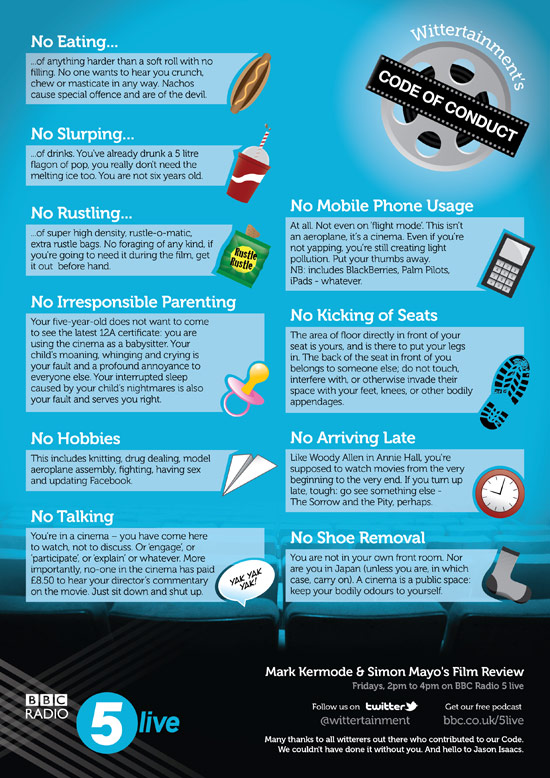
Luckily, this encounter was during the fifteen minutes-plus of adverts that seems to precede every big release nowadays. What I really can’t stand is talking while the film is actually on. That, and getting your phone out, are the real big no-nos of cinema etiquette. Maybe if we all followed Mark Kermode’s Wittertainment Moviegoers Code of Conduct , the local multiplex would be a better place to be for us all.


For all that’s bad about multiplexes however, they’re a necessary evil. Don’t blame the local Empire for showing Big Momma’s House 3 instead of something actually, y’know, good – blame your peers for paying to see Big Momma’s House 1 and 2 in the first place. I’m sure many cinema chains wish they could show interesting, thought-provoking films as opposed to the same old recycled tat. And whilst independent and arthouse cinemas such as Newcastle’s wonderful Tynside Cinema offer generally a much better quality of service, where else are you going to be able to see The First Avenger: Captain America, or Cowboys and Aliens or the latest guilty-pleasure Jason Statham vehicle when the time comes than at your multiplex? They may not offer the most preferable cinema experience, but, let’s face it: the audience and the industry would be pretty stuffed without them.

Sunday, 27 March 2011

Drive Angry 3D Review


The chance to watch Nicolas Cage donning yet another bizarrely terrible wig is one that cinemagoers shouldn’t pass up lightly. When you see that he’ll be co-starring with yet another toupee in a film called Drive Angry, presented in 3D? Well, to say no would be foolish.

First things first – Drive Angry 3D was obviously never going to be, and never aimed to be, an Oscar winner. But if there’s one thing in particular you can take from the film, it’s that it takes a trashy, silly, frankly ridiculous idea and takes it to every trashy, silly and frankly ridiculous conclusion you could wish for. The key to its moderate success is in this self-consciousness which acts as an ultimatum to the audience: go along for the ride, or stay well away.

Cage plays John Milton (yes, really), a dead man who has inexplicably escaped from Hell in order to avenge the death of his daughter and save the life of his baby granddaughter, who has been kidnapped for sacrificial purposes by a Satanist cult. In 3D. Along the way, Milton picks up a walking pair of gratuitously tiny hotpants (Amber Heard), and is pursued by the mysterious Accountant, a scene-stealing William Fichtner.

For what it is, Drive Angry is surprisingly good. Directed by Patrick Lussier, also behind fun horror My Bloody Valentine 3D, the film is a welcome blast of tongue-in-cheek excess after Oscar season. There’s everything you’d expect from a grindhouse project – little-to-no character development, copious nudity, gore and violence, as well as frequent knowing nods to the audience. Fichtner devours the scenery, while Heard is feisty and always watchable.

Cage’s performance is downright bizarre, which perhaps may just be the perfect thing for a film this mad. Whether he’s standing round mechanically, staring blankly at fires, drinking beer from a skull, or spewing out dialogue in monotone, it’s another chance to see how weird Cage can be at times. It’s also kind of entrancing – you literally have no idea what he’s going to do next.

If you enjoyed the likes of Machete and Planet Terror, there’s a decent chance that there’s at least something you’ll enjoy in Drive Angry 3D, with the eye-gouging nature of the 3D effects being particularly appropriate for the exploitative nature of the genre. If this is your sort of thing, it’ll be one of the most fun cinema experiences you’ve had in ages, otherwise avoid.

Verdict:
Drive Angry 3D is as crazy, unnatural and improbable as Cage’s wig, but it’s also loads of fun. There’s a scene featuring Cage having sex with a woman during a gunfight – cigar in mouth, gun in one hand, bottle of JD in the other. If that sounds like insane genius to you, see it.

Entertainment Value: 3.5/5
Genre Value: 4/5
Style: 2/5
Overall Rating: 3.5/5

Sunday, 20 February 2011

The Fighter Review


As the Oscar season gets well under way, the nominations are overdue a sports movie. Triumph over adversity, crowd-pleasing finales and the chance for an actor to physically transform themselves are often lapped up by voters, and there's a strong chance The Fighter could perform well come the end of February.

In the sports genre, the main problem can be that clichés are pretty much unavoidable. Most of the available narrative paths, even the moderately unconventional ones, have been trodden many times. With The Fighter, chances are you'll know where it's headed.

Yet that doesn't mean it isn't an enjoyable journey getting there. The film centres around the true story of boxer Micky Ward who tries to boost his career just as his crack-smoking brother Dicky, also a boxer, falls further into addiction and further away from his former glory days. With an expansive and controlling family, Micky may be forced to abandon his dependant brother to succeed.

The Fighter is dominated by a series of brilliant performances. Much has been made of Christian Bale's depiction of Dicky, and he is genuinely astonishing. Having lost considerable weight from his bulked-up Batman physique, Bale is simultaneously gaunt yet wide-eyed, funny and goofy, but also deeply saddening. As he slides evermore into his destructive addiction, the waste of Dicky's potential is deeply felt. It's an extremely physical role, and a complete departure from Bale's previous roles.

Amy Adams plays it tough and feisty as Micky's barmaid girlfriend, who opposes his hilariously defensive and devoted sisters, whilst Melissa Leo is excellent as Micky's mother and manager, convinced that being completely dedicated to family is a professional managerial style.

However, Mark Wahlberg is also fantastic as the calm, focused and weary eye of the surrounding tumultuous storm, completely grounding the film when it's in danger of focusing on too many larger-than-life characters. His Micky grants viewers a relatable pathway into the unfolding drama.

The boxing sequences, mostly in the film's second half, are gritty and realistic, well-choreographed and genuinely exciting. Wahlberg excels physically in these scenes, and adds emotion and humanity to the spectacle.

While The Fighter is full of excellent performances and is well made and interesting, it's difficult to become particularly involved in it. You'll sympathise with the characters, you'll marvel at Bale's exceptional performance, and enjoy the visceral fights, but it's not as heart-wrenching or moving as you might expect it to be, never making the leap from being simply a great film to a modern classic.

The Fighter doesn't offer much particularly new, but it is a great example of the boxing sub-genre. The final fight comes off as slightly underwhelming, but it's a solid and enjoyable way to spend a couple of hours, with excellent acting and a fun soundtrack.

Entertainment Value: 4/5
Genre Value: 4/5
Style: 4.5/5
Overall Rating: 4/5

Brighton Rock Review


After an acclaimed turn in the Ian Curtis biopic Control, Sam Riley leads an all-star British cast in a remake of the classic Brit-noir Brighton Rock as the iconic Pinkie, a violent young man struggling to make a name for himself in Brighton's criminal underworld.

When complications arise in a murder Pinkie carries out, he is forced to gain the sympathy of innocent bystander Rose, who holds circumstantial evidence of the crime.

Based upon Graham Greene's classic novel, Rowan Joffe's new adaptation shifts the drama from the 1930s to the context of the 60s mods and rockers conflict. While this accounts for an exciting central set piece, the decision seems somewhat superficial, not particularly adding much in terms of plot or themes.

The mods' and rockers' rivalry deserves better treatment, which would seem out of place within Brighton Rock's narrative.

However, Joffe's version begins promisingly – an ominous soundtrack, gloomy lighting and gorgeous cinematography set a menacing mood and the convoluted series of events that results in Pinkie and Rose's unlikely pairing is well orchestrated.

The problems arise in a flabby mid-section. Posters for the film boast of performances from Helen Mirren and John Hurt, yet Mirren's work as Ida, Rose's boss who is determined to get to the bottom of Pinkie's crime, feels disappointingly lazy and bland. Hurt has little to do except sit around and look concerned at the state of Brighton's crumbling society.

The biggest trouble with Brighton Rock is in the central relationship between Pinkie and Rose. The performances are excellent – Riley is brooding, with an undercurrent of fear and sadness, and Andrea Riseborough is absolutely brilliant as Rose, the troubled, beating heart of a film in desperate need of one.

However the script never gives the audience a reason to believe in the budding almost-romance between the pair. Pinkie is, frankly, a thoroughly unlikeable character, and it becomes difficult not to question quite why Rose remains so devoted to him.

The best antiheroes give you a reason to root for them even though you know you shouldn't really, but Joffe's screenplay never allows for this.

That said, Brighton Rock is worth a viewing. The film recovers slightly in its final act, with a dark and involving conclusion. It also looks beautiful – even though the 60s setting doesn't really work, the costumes and sets are fantastically realised, and the sweeping cinematography is striking. But there is always an annoying sense that Brighton Rock should be better than it actually is, and it's a feeling that's even harder to shake once you've left the cinema.

Entertainment Value: 2.5/5
Genre Value: 3/5
Style: 3.5/5
Overall Rating: 3/5

Saturday, 22 January 2011

Black Swan Review


After the absolute knock-out that was The Wrestler, director Darren Aronofsky returns, having eschewed the violent but achingly sad story of Randy "The Ram" for the high pressure and dramatic intensity of ballet with Black Swan.

Natalie Portman is Nina, a ballerina who dreams of one day dancing the Swan Queen in Swan Lake. She certainly has the skill and precision to play the White Swan, but lacks the roughness and tenacity to portray the character's evil side, the Black Swan. When she is cast in the part, Nina is forced to discover her own inner "Black Swan", driven to, and possibly beyond, the brink of her sanity.

The first hour of Black Swan is excellent – highly atmospheric from the off, with a majestic, heart-pounding opening scene that immediately pulls the audience into the film's dark core. Portman is very impressive, completely believable throughout Nina's personal disintegration, with her initial composure and timidity heightening the character's dramatic fall, piling on the tension. The score is terrifically atmospheric, full of sorrow, foreboding and malice.

While the first two-thirds are certainly extremely well made and performed, it's during the closing 30 minutes that Black Swan ignites with a surge of blazing intensity, becoming an absolute tour-de-force of emotion, eye-popping visuals and sweaty-palmed panic as the genre shifts from drama-thriller to full-blown psychological horror.

Black Swan is completely relentless, with strong elements of Cronenbergian body-horror – it sometimes seems like The Fly with ballet dancers.

However, like the ballet itself, there is an assured epic sweep, a high sense of grandeur – Black Swan is a completely sensory experience, melodramatic and overblown. That's a compliment.

Visually, Black Swan is absolutely jaw-dropping, from the costumes and sets of Swan Lake to the choppy editing in a pulse-pounding club scene, which, while totally jarring at first, incidentally becomes one of the standout moments. Aronofsky's trademark use of handheld cameras gives a visceral intimacy to the ballet sequences.

Despite looking at a completely different form of physical performance, strong thematic parallels can be seen between Black Swan and The Wrestler, particularly the fear of becoming obsolete and the bodily risks undertaken by performers. At times the dual imagery of the White and Black Swans is laid on a tad too thickly – mirrors are ever-present, becoming increasingly fragmented as Nina's psyche does, while images of swans, Rorschach blotches and doppelgangers abound, at times a little too obviously.

However, this is a sole and slight criticism of a genuinely astonishing film. Vincent Cassel and Mila Kunis turn in strong performances, but this is Portman's show. The roaring power of Black Swan's denouement will leave audiences breathless, terrified and ultimately speechless, with a spine-chilling, heart-stopping conclusion that lingers long in the memory. Black Swan is a highly deserving awards contender that needs to be seen in the cinema, and offers as much to the horror crowd as it does to ballet fans.


Entertainment Value: 5/5
Genre Value: 5/5
Style: 4.5/5
Overall Rating: 5/5

Tuesday, 7 September 2010

Tamara Drewe Review

Look at the posters for Stephen Frears’ latest release Tamara Drewe, and you’d be forgiven for thinking that it looked like an air-headed Bridget Jones-esque British comedy, perhaps funny but shallow and cheesy.

Hopefully this won’t put people off what is actually a much darker, satisfying and well-rounded film than first appears.

Frears has an excellent track record in his genre-hopping, consistently high quality career, winning over audiences and critics with the likes of High Fidelity and The Queen. Here, he takes on Posy Simmonds’ graphic novel of the same name, based loosely upon Hardy’s Far From the Madding Crowd, telling the story of the titular journalist who returns to her childhood home in the picturesque Dorset countryside, and becomes the epicentre of an increasingly twisting series of affairs and betrayals.

Tamara Drewe is a darker-than-expected treat, with a wonderfully mischievous tone. The characters are bewildered pawns manipulated over the plot, and the generally satirical comedy mocks pretentious authors and vacuous rock stars. It’s all extremely British.

It’s extremely satisfying to sit back and watch as the characters become evermore entangled as the plot moves further and further into farce. Overhanging all proceedings creeps a slightly uncomfortable feeling that soon everything will go horribly wrong.

Frears treads the line between comedy and drama finely, and whilst at times Tamara Drewe is very funny (mixing big laughs and a few smirks and giggles), it is also very affecting due to some fantastic performances. Tamsin Greig is absolutely brilliant as the put-upon housewife who creates her own idyllic countryside writer’s retreat but is constantly battered down by her husband’s (Roger Allam) infidelity and smarmy ego. Allam is excellent as the supremely vile Nick, while Bill Camp brings considerable heart in his well-judged, understated role as an American scholar with self esteem issues.

Also highly notable are Jessica Barden and Charlotte Christie as the two roguish schoolgirls who, through the sheer boredom of living in the dull, sleepy village Ewedown end up scheming and causing trouble that begins innocently enough, but snowballs to a dangerous level. Barden is truly hilarious – audiences may recognise her as a former cast member of Corrie, and her counterpart Christie, a complete newcomer, is also extremely funny.

All these supporting characters mean that, strangely enough, it is Arterton’s lead role that occasionally feels underdeveloped. Tamara’s motivations are difficult to uncover, and that’s partly the point – as a woman she has reinvented herself, but she suffers an identity crisis as a result. However, there is rarely any alone time with the character for the audience to get into her head, though Arterton does a great job with what she’s given in a much more interesting role than those she played in Price of Persia and Clash of the Titans.

Tamara Drewe is a smart, sophisiticated and genuinely funny British film that deserves your seven quid, and even holds up on repeat viewings. Don’t expect it to be overly frothy - embrace its moments of darkness and enjoy.

Entertainment Value: 4/5
Genre Value: 4/5
Style: 4/5
Overall Rating: 4/5